A finding is a checked outcome. A claim is the exact sentence that outcome supports. “Discovery” is only a badge after a fresh novelty review—not a separate pile of content.
Supported findingNOVELChecked 2026-08-31
Three circle-packing candidate records sent for independent verification
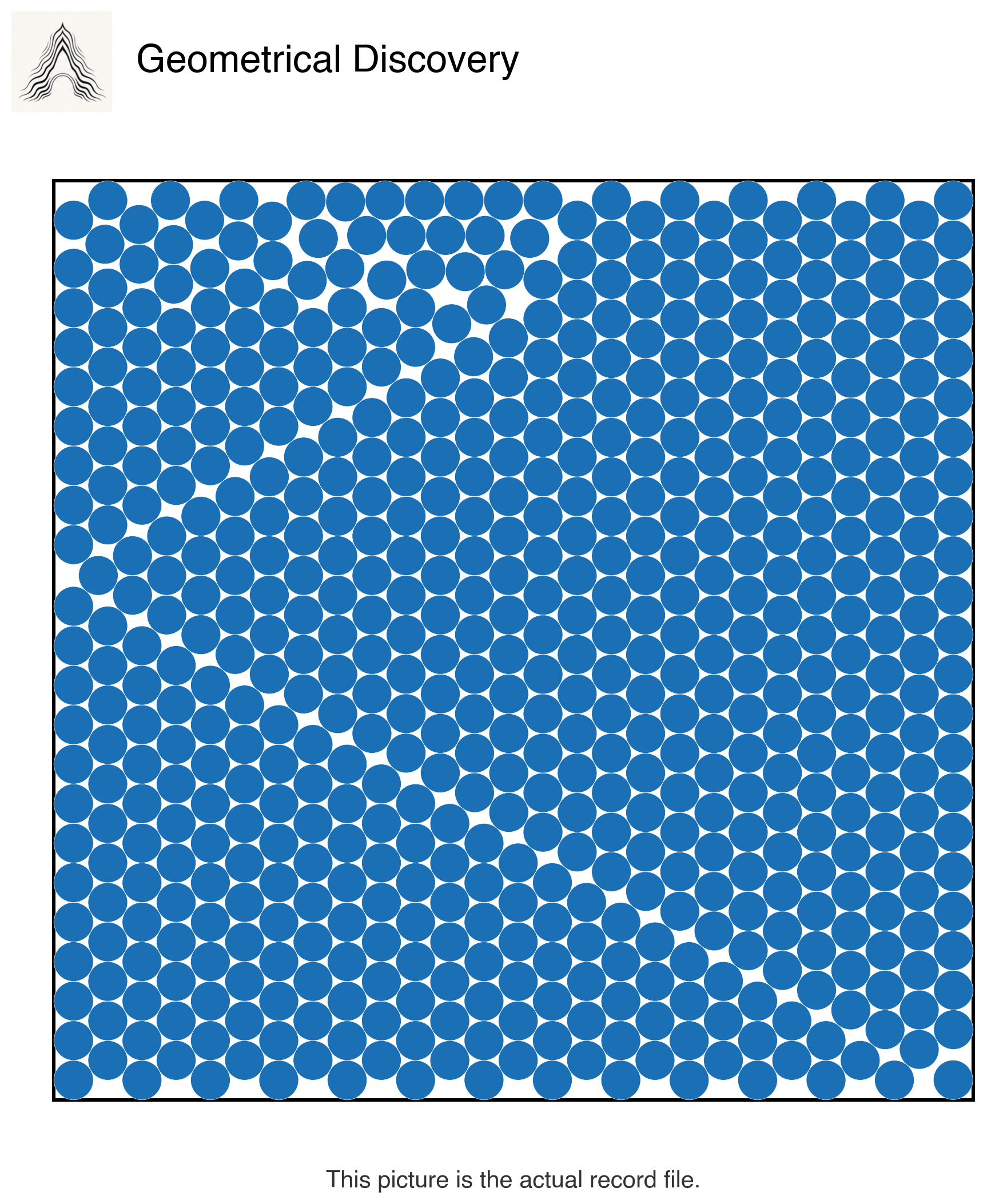
This picture is the actual record file: the 600-circle candidate packing, every circle at its certified position.
The result: Aletheia produced fixed coordinate files for 600, 700, and 800 equal circles in a square. A check that does not round the coordinates found that every circle stays inside the square and no two circles overlap. Each file supports a radius just above the value printed in the public Packomania catalog. These are candidate records, submitted to the catalog maintainer for verification. They are not accepted records and do not prove the best possible packings.
What it means: For each of three crowded square puzzles, the new file fits all the circles without overlap and is a little better than the public catalog entry. The catalog maintainer now has the files to check.
What it is NOT: Not three accepted records, because the catalog maintainer has not confirmed them. Not proof of the best possible packings, because one working layout cannot rule out a better one. Not universal proof of novelty, because private or unindexed stronger files may exist.
Next test that could settle it: The catalog maintainer reruns the three coordinate files and compares them with the current catalog and any earlier private files. Any failed wall or pair check, or any earlier equal or stronger file, removes that candidate.
Open question: Will the Packomania maintainer reproduce and accept the three packing candidates?
Receipts (exact limits and evidence records)
Claim ceiling (the strongest sentence this evidence supports): Three fixed coordinate files fit 600, 700, and 800 equal circles in a square at checked radii above the values printed in the public Packomania catalog. They are candidate records, submitted to the catalog maintainer for verification. They are not accepted records, do not prove the best possible packings, and do not rule out earlier private or unindexed results.
Novelty: Three fixed coordinate files pass full wall and pair checks at slightly larger radii and were sent to the catalog maintainer.
Supported findingCORRECTION NOT DISCOVERYChecked 2026-08-28
DeepMind's Formal Conjectures carried a stale A157225 statement; reported privately, confirmed and merged
The result: An audit of 16 computer-readable math problems in Google DeepMind's public Formal Conjectures collection found one whose statement had gone stale: OEIS A157225's source had recorded a published counterexample (716,993,899) that the formal copy did not reflect. Aletheia independently recomputed the counterexample, reported it privately, and a repository maintainer confirmed and merged the fix (PR #5114, 2026-08-24).
What it means: Google DeepMind keeps a public library of math problems written for computers. One entry was out of date: mathematicians had already partly settled it and the library still showed the old version. We checked the new number ourselves, told the team quietly, and they confirmed it and fixed the library within days. It is the second time an institution has corrected its records after one of our reports.
What it is NOT: Not a new math discovery, because a mathematician published the key number first and our role was catching the stale copy and verifying it; and not evidence the collection is broadly wrong, because of 16 entries audited only this one reached a supported mismatch and fourteen could not be judged either way.
Next test that could settle it: Resolve source bindings for the 14 unadjudicated files and rerun the frozen source-match audit across the collection.
Open question: How many entries in public formal mathematics collections disagree with their current upstream sources?
Receipts (exact limits and evidence records)
Claim ceiling (the strongest sentence this evidence supports): One dated repository correction, confirmed by the maintainers. Not a new mathematical discovery, not a claim about the rest of the collection (14 of 16 files could not be adjudicated either way).
Novelty: caught that the formal benchmark copy had not absorbed the update, recomputed the number independently, and obtained maintainer confirmation and a merged fix
Sixteen last-digit disagreements between the mass table editions are rounding ties, not errors
The result: The two published editions of the AME2020 mass table disagree on the final digit of 16 atomic masses at equal printed precision. A frozen check against the journal-printed table, a sibling file, and NUBASE2020 showed every printing loyal to its own production line: all 16 close as legitimate rounding-boundary cases with no demonstrable slip.
What it means: What looked like sixteen possible typos in the mass table turned out to be numbers sitting exactly on a rounding boundary, printed honestly by two different production passes.
What it is NOT: Not proof the sixteen rows are error-free, because a slip matching every printing of its own family would look identical; it is proof no public printing can show one.
Next test that could settle it: None; the class is resolved and closed.
Open question: Are the 16 last-digit disagreements between the two published AME2020 editions production slips or rounding ties?
Receipts (exact limits and evidence records)
Claim ceiling (the strongest sentence this evidence supports): Production and rounding structure of the 16 published rows only; a slip that matches every printing of its own family would look identical, so the claim is that no public printing can demonstrate one.
Novelty: first documentation and resolution of the equal-precision edition disagreements
Thirteen unexplained arithmetic contradictions in the nuclear structure archive, reported privately, pending maintainer review
The result: Of 299,105 placed gamma records in the ENSDF nuclear structure archive, 61 fail their own level-scheme arithmetic beyond ten times the stated uncertainties. The archive explains 48 of them through its own footnotes and source structure, and 13 have no documented explanation and no consistent placement in any sibling dataset, with a blind second classification agreeing on all 13. They were reported privately to the maintainers first and their identities are withheld here pending that review.
What it means: Thirteen records in the world reference archive of nuclear structure contradict their own arithmetic with no explanation anywhere in the archive, and the people who maintain it now have the list.
What it is NOT: Not thirteen confirmed errors, because the maintainers may recognize some as known issues or evaluation practice, and their answer is the real test.
Next test that could settle it: The maintainers reply adjudicates each record as known, explained, or new; identities and per-record receipts publish after their review or a courtesy window.
Open question: Do the unexplained ENSDF arithmetic contradictions survive maintainer adjudication as real bookkeeping errors?
Receipts (exact limits and evidence records)
Claim ceiling (the strongest sentence this evidence supports): Archive bookkeeping structure of the flagged records only; dual-arm exploratory candidates whose decisive adjudication is the maintainers reply; no record is called a confirmed error.
The world's atomic mass table is arithmetically airtight
The result: Every derived column of the AME2020 atomic mass tables (binding, beta-decay, separation, and reaction energies) was recomputed from the primary masses with exact arithmetic: 51,937 checks per rounding envelope and zero inconsistent rows, with the whole audit independently reproduced by a second system.
What it means: The reference book of nuclear masses agrees with its own arithmetic everywhere we checked, which is a verified clean bill for a table thousands of papers copy from.
What it is NOT: Not proof the underlying measurements are right, because columns computed from the same fit must agree unless production slips; only production consistency was certified.
Next test that could settle it: Point the proven verifier at the human-curated ENSDF gamma-level archive, where agreement is not entailed by one adjustment (done: see the companion cards).
Open question: Do the published AME2020 mass-table columns agree with their own arithmetic within printed precision?
Receipts (exact limits and evidence records)
Claim ceiling (the strongest sentence this evidence supports): Internal arithmetic structure of the published AME2020 distribution files only; agreement between columns computed from one adjustment certifies production consistency, not experimental truth.
Novelty: a third-party audit of the published output files arithmetic, including the rounded edition, which no source was found to have done
Deeper experiences are the ones people call impossible to put into words
The result: In 4,630 NDERF records, people answering YES to "was the experience difficult to express in words?" score higher on the standard depth scale than NO answerers (medians 16 vs 14, effect size 0.126, p=1.4e-13, confirmed independently twice). Present in both submission eras, stronger later. Cannot-describe language runs 17.6% in these narratives vs 0.77% in tinnitus patients describing their own hard-to-convey symptom (descriptive; survives length matching). This is a quantitative confirmation of a known feature of deep experiences, with receipts: preregistered rules, a sealed blind coding packet judged by a fresh isolated coder at 30/30 on every load-bearing category, and four adversarial review cycles, one of which caught and retracted an era-analysis error.
What it means: People are not sprinkling 'indescribable' around at random. The ones who say words fail are the ones whose experiences went deepest, and that pattern is strong enough to build on: it means the failure of language is itself a structured, studyable part of these experiences.
What it is NOT: Not proof the experiences are truly beyond language, because 'words cannot describe it' is also a phrase people learn from books and other tellers, and the questionnaire asks the question directly which nudges yes answers. Not a claim about verified persons, because the archive cannot confirm identities, so counts are distinct records.
Next test that could settle it: Recover NDERF questionnaire form history to test whether an instrument change explains the era strengthening
Open question: Does a documented NDERF questionnaire form change explain why the ineffability-depth association is stronger in later submissions?
Receipts (exact limits and evidence records)
Claim ceiling (the strongest sentence this evidence supports): Self-report answer vs self-report depth score, same sitting, one self-selected archive; records not verified persons; no mechanism, causality, or novelty claim.
Novelty: population-scale quantification of the structured archive answer against Greyson totals with sealed blind coding, independent recomputation, and submission-date era analysis
Four answers track experience depth, and knowing about NDEs beforehand does not
The result: In 4,354 NDERF records, four questionnaire answers track depth scores in both the older and newer halves of the archive: saying you gained information about God, saying you gained special knowledge, reporting MORE consciousness than in normal life during the event, and still believing today the experience was real. And one clean near-zero: people who had heard of near-death experiences before their own score exactly as deep as people who never had (correlation +0.002 across 3,239 records). All of this is exploratory, not confirmed: the adversarial review found an ambiguity in one statistical control and a rule fix made after results were open, which caps every label until a repaired rerun on fresh records.
What it means: What people say they brought back from the experience tracks how deep it scored, and the cultural-script worry took a real hit: knowing the NDE story beforehand gives exactly zero extra depth. If people were retelling a script they had learned, the ones who knew it should score deeper, and they do not.
What it is NOT: Not confirmed findings, because the review caught an ambiguous control rule and an after-the-fact label fix, which by this lab's own rules caps everything at exploratory until a clean rerun. Not proof the experiences are real or accurate, because every measure is what one person says about themselves in one sitting. Not four independent discoveries, because two of the four answers partly overlap what the depth score already asks about.
Next test that could settle it: A repaired rerun with the control formula frozen exactly and decision rules tested on fake data first, judged on NDERF records submitted after 2026-08-15 that no one has seen yet
Open question: Do the four exploratory depth-linked answers survive a repaired frozen rerun judged on NDERF records submitted after 2026-08-15?
Receipts (exact limits and evidence records)
Claim ceiling (the strongest sentence this evidence supports): Associations among self-reported answers in one self-selected archive, same sitting; two of the four overlap the depth scale in meaning; exploratory pending a repaired rerun; no causal, accuracy, or mechanism claim
Novelty: archive-scale test (n 3,200-4,354) with held-out era split, frozen multiplicity control, blind-audited option coding, and a bounded near-null rather than a bare non-significant test; currently exploratory pending repaired rerun
Variant-aware scoring shifts an EVOBC lookup score
The result: Across 100 fixed 9:1 simulations on EVOBC, accepting Unicode-listed variant labels raised an exact-copy lookup score by a median 2.4386 percentage points. A stricter simplified, traditional, and shape-variant rule raised it by 1.5416 points. The pinned Chinese-label character tree matched all 229,170 English-tree records and recovered 9,365 of 219,004 exact-image families assigned across labels. The effect on the paper's trained models is unknown because the original split and per-image predictions remain unavailable.
What it means: A published AI benchmark for reading ancient Chinese characters scores models as wrong when they give a valid variant form of the right answer. Accepting documented variants shifts a lookup score by around two percentage points, enough to matter in model comparisons.
What it is NOT: Not a correction of the paper's published model scores, because the original test split and predictions are not public. Not a claim that every variant reading is legitimate, because only Unicode-documented relations were accepted.
Next test that could settle it: Obtain the original evaluation split and per-image predictions and rescore them against a documented source-backed relation table.
Open question: How do the paper's trained-model scores change under a source-backed variant-aware evaluation?
Receipts (exact limits and evidence records)
Claim ceiling (the strongest sentence this evidence supports): EVOBC exact-copy score sensitivity under the frozen Unicode variant rules and the pinned Chinese-label character-tree reconciliation. No correction to the paper's trained-model scores and no claim that every alternate reading is source-validated.
Novelty: I supply the EVOBC-specific 229,170-image census, frozen exact-copy scoring sensitivity, and pinned Chinese-label reconciliation.
Supported findingREDISCOVERY NOT NOVELChecked 2026-08-04
Public quantum-switch counts reproduce the published inequality score
The result: Two separate implementations reconstructed the public July 2025 quantum-switch counts and obtained 1.8328528, matching the paper's rounded 1.8328 against a fixed-order bound of 1.75. The paper's stated uncertainty of 0.0045 is larger than every count-only model tested here. This checks the released arithmetic. It cannot close the experiment's acknowledged detection, setting-choice, spacetime, or time-linked drift loopholes.
What it means: The released data behind a headline quantum-causality experiment checks out: two independent reconstructions of the public counts land exactly on the published score, comfortably above the classical bound. The arithmetic holds.
What it is NOT: Not confirmation of the experiment's big claim, because the acknowledged loopholes (detection, setting choice, drift) live upstream of the released counts. Not a replication, because no new data was collected.
Next test that could settle it: Release or collect repeated time blocks with randomized settings so time-linked drift and setting-order effects can be measured directly.
Open question: Does the quantum-switch inequality remain above 1.75 when settings are randomized and analyzed in repeated time blocks?
Receipts (exact limits and evidence records)
Claim ceiling (the strongest sentence this evidence supports): Exact arithmetic of the pinned Zenodo v2 aggregate counts and bounded count-model sensitivity only. No loophole-free indefinite-causal-order, no-drift, mechanism, or novelty claim.
Novelty: Aletheia independently reconstructs every released term, audits multiple count models, and freezes failure tests without claiming a new physical effect.
The result: Aletheia identified eight internally inconsistent NASA/JPL close-approach records. JPL confirmed an issue affecting pathological cases with close approaches to multiple bodies within a short time window and fixed it for 367943, saying the other cases should be fixed as well. Aletheia's live check confirmed all eight reported records now satisfy the distance-order invariant.
What it means: Eight records in NASA/JPL's asteroid close-approach database contradicted themselves, the error report was sent in, and JPL confirmed the software issue and corrected the data. An outside one-person check improved a flagship public dataset.
What it is NOT: Not a sign of broader JPL unreliability, because the issue hit a narrow class of unusual multi-body cases. Not an astronomical discovery, because the errors were bookkeeping inconsistencies, not new objects.
Next test that could settle it: Re-run the public live checker after future JPL data releases and investigate any recurrence before making a broader reliability claim.
Open question: Do the eight corrected JPL close-approach records remain internally consistent after future data releases?
Receipts (exact limits and evidence records)
Claim ceiling (the strongest sentence this evidence supports): Eight reported records were internally inconsistent; JPL confirmed the relevant issue class and one corrected example; all eight now pass the live invariant. No claim about orbit errors, astronomical anomalies, or unrelated JPL systems.
Novelty: Aletheia supplied the reproducible eight-record diagnosis and independently verified the post-fix state.
The result: All nine frozen machine cases for the seven-vertex rainbow-stacking problem are closed as unsatisfiable. Six have direct checked certificates. Three have checked symmetry-reduced certificates plus a reviewed transfer argument. This is a conditional resolution pending human review of the encoding and mathematical reductions.
What it means: A seven-vertex math problem was closed by machine: all nine required cases are proven impossible, six directly and three through a checked symmetry argument. Pending one human review of the setup, the question is resolved.
What it is NOT: Not yet a finished theorem, because a human mathematician must still validate the encoding and the reduction steps. Not a general method claim, because the certificates cover exactly these nine formulas.
Next test that could settle it: Human mathematician review of the full reduction from Question 3.3 to the nine formulas.
Open question: Does human mathematical review confirm that the nine checked formulas exactly resolve Question 3.3 for n=7?
Receipts (exact limits and evidence records)
Claim ceiling (the strongest sentence this evidence supports): The nine machine cases are closed; resolution of Question 3.3 at n=7 remains conditional on human validation of the encoding, split, R3 semantics, small-weight closures, and symmetry transfer.
Novelty: Aletheia closes the nine-case machine search for n=7 with checked certificates; the theorem-level translation remains under human review.
The result: Validated markers in 2,192 OBERF narratives follow a coarse order in the telling: onset/body markers early, tunnel and light mid-narrative, felt presence after them, return-to-body last; p=1e-4 in both corpus halves under an event-set-preserving null. Early-cluster internal order is not stable, so the supported claim is a coarse gradient, not a step-by-step sequence.
What it means: People telling out-of-body stories follow a shared coarse order: how it started comes early, tunnel and light land mid-story, a felt presence after them, and the return to the body last. Two thousand narratives beat shuffled versions of themselves at odds of one in ten thousand, in both halves of the archive.
What it is NOT: Not the order events were experienced in, because this measures how stories are told. Not a fine-grained sequence, because the early markers swap order freely and only the coarse gradient is supported.
Next test that could settle it: Frozen replication on the independently collected NDERF corpus with a second precision rater.
Open question: Does the coarse telling-order gradient replicate in the independently collected NDERF corpus?
Receipts (exact limits and evidence records)
Claim ceiling (the strongest sentence this evidence supports): Telling order of validated markers in one corpus; not an experienced-event sequence; early-cluster order unstable.
Novelty: Preregistered, precision-gated marker measurement with permutation nulls and split replication on an OBE corpus; telling-order claim ceiling
Structure audit of the 1974-2018 ganzfeld study database
The result: In the public 128-study ganzfeld compilation: pooled excess +376.2 hits over the ~5,459-trial chance expectation (p<1e-5), robust to greedy removal of 46 of 128 studies; decline over time absent at the frozen 0.01 threshold; small-study association suggestive only (p=0.019-0.047). Structure of the compiled file; upstream selection untested; no psi conclusion either way.
What it means: The public database of 128 telepathy-style ganzfeld studies really does contain more hits than chance predicts, and the excess survives removing a third of the studies and shows no fade over time. Whatever explains it, the compiled numbers themselves are not fragile.
What it is NOT: Not evidence for telepathy, because the audit tested only the structure of the compiled table and upstream publication selection remains untested. Not a final word, because the same frozen audit on an independent compilation is the named next step.
Next test that could settle it: Same frozen audit on the independent Tressoldi MA_GanzfeldESP compilation.
Open question: Does the database-level structure (robust pooled excess, no decline, weak small-study signal) hold in the independent Tressoldi compilation?
Receipts (exact limits and evidence records)
Claim ceiling (the strongest sentence this evidence supports): Structure of one proponent-compiled database; upstream publication/selection effects untested; no psi conclusion.
Novelty: Frozen pre-registered thresholds, greedy fragility count, duplicate sensitivity, and independent exact-tail reproduction on the 2018 compilation
De-identified dream reports can be linked across time
The result: Closed-set pseudonymous linkage within DreamBank after obvious content clues were removed.
What it means: Dream reports are individually distinctive enough that the same anonymous dreamer can be re-identified across time inside an archive even after obvious clues are removed. Anonymized dream text is not as anonymous as it looks.
What it is NOT: Not real-name identification, because the test only matched pseudonymous records to each other inside one closed archive. Not a privacy verdict on all dream data, because open-set testing with separated recorders is the named next step.
Next test that could settle it: Independent open-set cohort with recorder/transcriber separation.
Open question: Does dream-report linkage generalize to independent open-set contributors?
Receipts (exact limits and evidence records)
Claim ceiling (the strongest sentence this evidence supports): Closed-set pseudonymous archive linkage, not real-name identification.
Novelty: Aletheia directly measures closed-set pseudonymous linkage across 20 contributors after removing obvious names and content clues, with an explicit privacy framing.
New verification requiredNovelty not reviewedChecked 2026-07-23
Sleep paralysis and near-death reports lead with different body signatures
The result: Sleep-paralysis and NDE source-coded corpora support a trigger-specific Layer-1 body-boundary signature: sleep paralysis is led by paralysis/presence (7.209% / 8.909%), while NDE is led by vestibular separation/presence (17.76% / 14.269%).
What it means: The two experiences open differently in the telling: sleep-paralysis stories lead with being frozen and sensing a presence, while near-death stories lead with floating free of the body plus a presence. If that holds under validated labels, the trigger shapes the body story.
What it is NOT: Not usable as evidence yet, because the percentage contrasts rest on machine labels that must first pass a blinded human check. Not a mechanism claim, because word patterns in stories cannot show what the body did.
Next test that could settle it: Independently validate paralysis, presence, and vestibular labels on blinded rows, then recompute the corpus contrast.
Open question: Do G-LOC, syncope, coma, anesthesia, sleep-paralysis, and NDE data preserve trigger-specific body-boundary patterns?
Receipts (exact limits and evidence records)
Claim ceiling (the strongest sentence this evidence supports): No claim authority.
New verification requiredNovelty not reviewedChecked 2026-07-23
Life reviews travel with deceased relatives, not with the light
The result: NDE life-review rows behave like a memory/social-affiliation subtype rather than a generic light/OBE subtype: within coded NDE life-review rows, deceased-relative co-occurrence is 58.14%, while bright-light co-occurrence is 16.279%.
What it means: Inside near-death stories that contain a life review, deceased relatives appear far more often than the famous bright light does. The life review may belong to a memory-and-family cluster of the experience rather than to the light-and-tunnel cluster.
What it is NOT: Not confirmed, because the coded rows behind the two percentages must be recovered and blindly re-validated before the contrast counts. Not a claim about real deceased persons, because these are story elements.
Next test that could settle it: Recover the coded rows, validate life-review/deceased-relative/light labels blindly, and reproduce both denominators.
Open question: Is the reported life-review/deceased-relative subtype reproducible from validated NDE rows?
Receipts (exact limits and evidence records)
Claim ceiling (the strongest sentence this evidence supports): No claim authority.
Bounded nullNovelty not reviewedChecked 2026-07-20
Closed: the wet-versus-dry vision replay is parked until better data
The result: Preregister a message-structure-only replay of the dry/open versus wet/enclosed hypothesis, anchored on the existing Marian negative result and excluding entity-affect endpoints.
What it means: A planned replay of the idea that dry, open landscapes produce different vision reports than wet, enclosed ones was specified and then parked: it only runs if two independent report collections can fill its cells.
What it is NOT: Not a result, because the test never ran. Not abandoned, because the frozen design sits ready and names exactly what data would trigger it.
Next test that could settle it: Before replay, freeze message-structure labels, four setting cells, corpus/era/tradition/source-length controls, and a holdout corpus. Run only if at least two practice-independent corpora can populate every comparison cell.
Open question: Do the broad climate/environment formulations survive current matched controls?
Receipts (exact limits and evidence records)
Claim ceiling (the strongest sentence this evidence supports): No claim authority.
Bounded nullNovelty not reviewedChecked 2026-07-20
Closed: the humid-climate trickster analysis will not be rerun
The result: Repeat the broad humid-climate/lower-trickster and blinded 120-row entity-affect analyses as a new wonder item.
What it means: An older analysis linking humid climates to "trickster" entity reports is formally retired: no rerun unless a genuinely new measurement-grade dataset appears, because the old material cannot separate writing style from actual exposure.
What it is NOT: Not a null result, because the question was closed as untestable with current data rather than answered. Not censorship of the idea, because the reopening condition is written down.
Next test that could settle it: No replay. Reopen only if a materially new measurement-grade exposure dataset appears and a preregistered matched design distinguishes source style from exposure.
Open question: Do the broad climate/environment formulations survive current matched controls?
Receipts (exact limits and evidence records)
Claim ceiling (the strongest sentence this evidence supports): No claim authority.
Bounded nullNovelty not reviewedChecked 2026-07-04
No shared brain signature links DMT trips and near-death states
The result: No shared brain signature appeared in the tested DMT EEG data; stronger test needs high-density paired data.
What it means: The tested brain recordings show no specific shared signature between DMT experiences and near-death states beyond what shared vocabulary and generic altered-state effects already explain. The popular "DMT model of the NDE" gets no support at this resolution.
What it is NOT: Not a disproof of any DMT-NDE connection, because the available recordings are low-density and a stronger test needs paired high-density data with validated NDE scoring. Not a claim about chemistry, because only electrical brain data was tested.
Next test that could settle it: High-density DMT/ketamine EEG with validated NDE scoring.
Open question: Do DMT and NDE reports share a specific signal beyond vocabulary and generic altered-state content?
Receipts (exact limits and evidence records)
Claim ceiling (the strongest sentence this evidence supports): No shared signature detected at tested resolution.
Exploratory outcomeNovelty not reviewedChecked 2026-07-04
The dream-report brain correlate looks like sleep depth, not dreaming
The result: A reproducible slow-wave correlate appeared but is most consistent with arousal or sleep depth.
What it means: A brain-wave correlate of dream reporting does reproduce, but it behaves like ordinary arousal or sleep depth rather than a signature of the dream itself. A promising signal, most likely explained by the boring variable.
What it is NOT: Not a dead end, because absolute-power and source-localized replication with stage controls could still separate dreaming from depth. Not a confirmed dream marker, because the boring explanation currently fits.
Next test that could settle it: Absolute power and source-localized replication with stage/time controls.
Open question: Is the dream-report EEG correlate more than arousal or sleep depth?
Receipts (exact limits and evidence records)
Claim ceiling (the strongest sentence this evidence supports): A confounded archive-local physiological correlate.
Bounded nullNovelty not reviewedChecked 2026-06-18
Closed: the dry-open vision kill test is specified and shelved
The result: Dry/open prophetic-vision reframe kill test: use the Marian arid/semi-arid negative result as the anchor falsifier and only test setting-by-message-structure interactions after separating dry/open, dry/enclosed, wet/open, and wet/enclosed contexts.
What it means: The strongest version of the landscape-vision idea got a preregistered kill test: four setting types, message-structure labels frozen before looking, and the arid Marian negative as the built-in falsifier. It waits on data.
What it is NOT: Not evidence for or against the idea, because this object is a frozen test design. Not redundant with the other vision questions, because this one fixes the exact kill rule.
Next test that could settle it: Pre-register message-structure labels before looking at setting bins; compare prophetic/revelatory, instruction, warning, healing, and place-sanctification markers across the four environmental cells.
Open question: Do the broad climate/environment formulations survive current matched controls?
Receipts (exact limits and evidence records)
Claim ceiling (the strongest sentence this evidence supports): No claim authority.
The psychedelic brain-complexity rise is mostly a spectral artifact
The result: In two raw psychedelic-EEG datasets (ketamine and DMT), apparent increases in signal-diversity complexity (Lempel-Ziv) are largely explained by flattening of the 1/f aperiodic slope; after controlling for the aperiodic exponent, no separable complexity effect remains in these datasets.
What it means: In ketamine and DMT brain recordings, the celebrated rise in signal "complexity" mostly disappears once you account for a simple change in the overall shape of the frequency spectrum. The flagship complexity story largely reduces to a known, simpler measurement effect in these datasets.
What it is NOT: Not a claim that psychedelics do nothing to the brain, because the spectral change itself is real and large. Not universal, because two public datasets were tested and a person-level preregistered replication is the named next step.
Next test that could settle it: Replicate prospectively with person-level raw EEG and preregistered spectral controls.
Open question: Does the LZc effect remain absent after preregistered aperiodic control in new raw EEG?
Receipts (exact limits and evidence records)
Claim ceiling (the strongest sentence this evidence supports): Bounded corpus/measurement result; no mechanism or universality.
Novelty: Aletheia tests the specific 1/f aperiodic exponent as the confound in both ketamine and DMT raw datasets and reports no separable drug effect after that control.
Bounded nullNovelty not reviewedChecked 2026-06-03
Closed: the desert-vision idea now carries its own disproof anchor
The result: Does the dry/desert prophetic-vision hypothesis survive after the Marian-apparition arid/semi-arid negative result is treated as a potential disconfirmation rather than a weak exception?
What it means: The idea that prophetic visions favor desert settings must now face the strongest counter-evidence first: Marian apparitions in arid regions came out negative. Any future test starts from that disproof, not around it.
What it is NOT: Not a kill of the desert idea, because the decisive matched comparison has not run. Not support either, because the one anchor result points the other way.
Next test that could settle it: Identify the exact matched prophetic/revelatory variables, compare arid/semi-arid versus humid strata by corpus and source channel, and define a kill rule for the dry/desert prediction.
Open question: Do the broad climate/environment formulations survive current matched controls?
Receipts (exact limits and evidence records)
Claim ceiling (the strongest sentence this evidence supports): No claim authority.
Hessdalen sighting days track observing conditions, not geomagnetics
The result: In the full-date Hessdalen event corpus, dated observations behave as an observation-ecology result rather than a physical explanation: event days are not elevated on same-day Kp against matched +/-7/14/21/28 day controls, while precipitation and wind-gust metrics are lower than controls. This claim does not explain what the Hessdalen lights are, does not claim weather causes the phenomenon, and does not refute geomagnetic hypotheses generally; it only says same-day Kp is not elevated in this bridge. Weather evidence is Open-Meteo reanalysis-grid data, not direct station instrument logs for every event.
What it means: On days people report the Hessdalen lights, the geomagnetic index is no higher than on matched nearby days, but the weather is drier and calmer. Sighting days look like good-viewing days, which says the reporting record tracks when people can see, before it tracks anything about the lights.
What it is NOT: Not an explanation of the Hessdalen lights, because the analysis only tested day-matching against indexes and reanalysis weather. Not a refutation of geomagnetic ideas generally, because it covers same-day Kp in this one dated corpus with grid weather, not station instruments.
Next test that could settle it: Replicate with direct station data and independent observation dates.
Open question: Does the matched weather/Kp result replicate on direct station data and held-out dates?
Receipts (exact limits and evidence records)
Claim ceiling (the strongest sentence this evidence supports): Bounded corpus/measurement result; no mechanism or universality.
Novelty: Aletheia applies matched +/-7/14/21/28-day controls to dated reports and separates same-day Kp non-elevation from lower reanalysis precipitation/gust observation ecology.
Exploratory outcomeNovelty not reviewedChecked 2026-05-30
Light imagery splits into inner-state stories and sighting stories
The result: NDE and dream-report corpora show high visual-light/altered-state proxies while UAP report corpora show visual-light without the same internal-state framing; this suggests a separable altered-state imagery mechanism rather than a single generic light-reporting effect.
What it means: Bright-light imagery shows up in two different ways: near-death and dream stories wrap the light in language about their own inner state, while UFO sighting reports mention light without that inner framing. The light in a vision and the light in a sighting may be two different kinds of report.
What it is NOT: Not a confirmed mechanism, because the labels came from automated text matching that has not been independently validated. Not a claim about what anyone actually saw, because these are word patterns in stories.
Next test that could settle it: Re-run with source-locked human/LLM labels and matched report-purpose controls.
Open question: What survives when the exploratory light separation pattern is tested on validated held-out labels?
Receipts (exact limits and evidence records)
Claim ceiling (the strongest sentence this evidence supports): Exploratory substrate only.
Exploratory outcomeNovelty not reviewedChecked 2026-05-30
UAP reports differ from official controls as a bundle, not one feature
The result: UAP report corpora appear to differ from official/fireball controls not just in visual-light frequency but in the bundle of light, motion, and shape proxies, consistent with reporting-ecology and observer-opportunity mechanisms.
What it means: UFO reports do not differ from official aviation and fireball reports on just one feature. They differ as a package of light, motion, and shape wording at once, which is what you would expect if who reports and how they get to report shapes the stories.
What it is NOT: Not evidence about what UAP are, because the pattern tracks reporting channels, not objects. Not confirmed, because the coding needs one shared instrument applied to matched sources before it can be trusted.
Next test that could settle it: Replicate with matched official and eyewitness sources under one coding instrument.
Open question: What survives when the exploratory uap reporting ecology pattern is tested on validated held-out labels?
Receipts (exact limits and evidence records)
Claim ceiling (the strongest sentence this evidence supports): Exploratory substrate only.
Exploratory outcomeNovelty not reviewedChecked 2026-05-30
When normal senses quiet down, inner imagery gets louder
The result: Across NDE and dream-report corpora, sound, motion, and physiological proxies suggest a bounded sensory-reduction transition pattern: internally generated perception becomes more salient when ordinary sensory anchoring is reduced. Ganzfeld/protocol-experiment material is excluded from canonical support and retained only as experimental follow-up pending EP-PROTO controls.
What it means: Across near-death and dream stories, sound, motion, and body signals point the same direction: when ordinary sensory input drops away, internally generated perception takes over and becomes the story. This fits sleep onset, sensory deprivation, and near-death settings alike.
What it is NOT: Not proof of one shared mechanism, because the pattern comes from word proxies that have not passed a matched control test across settings. Not a statement about experiment data, because protocol studies were deliberately excluded here.
Next test that could settle it: Run the matched Ganzfeld/hypnosis/dream/sleep-paralysis control test.
Open question: Does a sensory-reduction pattern survive matched Ganzfeld, hypnosis, dream, and sleep-paralysis controls?
Receipts (exact limits and evidence records)
Claim ceiling (the strongest sentence this evidence supports): Exploratory substrate only.
Exploratory outcomeNovelty not reviewedChecked 2026-05-30
The electromagnetic keyword fails its own consistency test
The result: The broad electromagnetic proxy appears in unrelated corpora, suggesting measurement-invariance failure rather than a real cross-domain electromagnetic mechanism.
What it means: The word patterns used to detect "electromagnetic effects" fire in collections that have nothing to do with each other. That means the detector is measuring language habits, not a real cross-domain electromagnetic signal. A useful negative: it killed a tempting bridge.
What it is NOT: Not a statement that electromagnetic effects never occur in any report, because the failure is in the measuring stick. Not final, because a manual reading of the split meanings is still the named next step.
Next test that could settle it: Manually adjudicate split EM meanings across independent corpora.
Open question: What survives when the exploratory em measurement invariance pattern is tested on validated held-out labels?
Receipts (exact limits and evidence records)
Claim ceiling (the strongest sentence this evidence supports): Exploratory substrate only.
Exploratory outcomeNovelty not reviewedChecked 2026-05-30
Near-death stories carry meaning-of-death content that dreams do not
The result: Full-registry rows suggest NDE claims cluster death/afterlife, memory, and peace/love semantics differently from dream rows, implying that transition meaning rather than imagery alone may separate NDE-like material from ordinary dreams.
What it means: What separates near-death stories from ordinary dreams may not be the pictures but the meaning: death, afterlife, memory, and peace-and-love themes cluster differently in near-death material than in dream archives.
What it is NOT: Not a validated separator yet, because the meaning labels came from automated matching and the locked comparison test has not run. Not a claim that the experiences differ in nature, because this measures how they are told.
Next test that could settle it: Run the locked NDE/DreamBank meaning-communication contrast.
Open question: Do NDE and DreamBank meaning/communication contrasts survive source, length, and ontology controls?
Receipts (exact limits and evidence records)
Claim ceiling (the strongest sentence this evidence supports): Exploratory substrate only.
Exploratory outcomeNovelty not reviewedChecked 2026-05-30
Instrument-backed UAP cases separate from story-only cases
The result: Across the full registry, UAP rows separate instrument-backed cases from generic light/motion narratives, suggesting that evidence modality should be modeled as an independent axis rather than blended into phenomenological features.
What it means: UAP reports with instrument evidence (radar, camera, sensor) look different from purely narrative reports, which means "what kind of evidence exists" deserves to be its own axis instead of being blended into what the report says happened.
What it is NOT: Not a verdict on any case, because the evidence-channel labels have not been validated on held-out reports. Not a claim that instrument cases are more real, because better instruments may simply travel with different reporting channels.
Next test that could settle it: Validate evidence-channel labels and outcome differences on held-out cases.
Open question: What survives when the exploratory uap evidence channel pattern is tested on validated held-out labels?
Receipts (exact limits and evidence records)
Claim ceiling (the strongest sentence this evidence supports): Exploratory substrate only.
Exploratory outcomeNovelty not reviewedChecked 2026-05-30
Fighter-pilot blackouts produce fragments, not the full package
The result: G-LOC and acute-hypoxia narratives suggest a recoverable transition subtype: sensory/motor fragments and dreamlets can occur without the full canonical NDE package, especially without prominent life review or deceased-relative encounter.
What it means: When fighter pilots black out from G-forces, they report dreamlets and sensory fragments but usually not the full near-death package with life review and deceased relatives. Brief oxygen loss alone seems to produce a lighter version, which makes the full package more interesting.
What it is NOT: Not a controlled comparison, because the blackout accounts come from scattered sources without matched denominators. Not proof the full package needs something beyond oxygen loss, because duration and context differ wildly between a centrifuge and a cardiac arrest.
Next test that could settle it: Acquire raw/prospective G-LOC or syncope reports with controls.
Open question: Do G-LOC, syncope, coma, anesthesia, sleep-paralysis, and NDE data preserve trigger-specific body-boundary patterns?
Receipts (exact limits and evidence records)
Claim ceiling (the strongest sentence this evidence supports): Exploratory substrate only.